Tuesday, August 12, 2014

give

give someone awayreveal hidden information about someoneHis wife gave him awayto the police.
give someone awaytake the bride to the altarMy father gave me awayat my wedding.
give something awayruin a secretMy little sister gave the surprise party away by accident.
give something awaygive something to someone for freeThe library was giving away old books on Friday.
give something backreturn a borrowed itemI have to give these skates back to Franz before his hockey game.
give inreluctantly stop fighting or arguingMy boyfriend didn't want to go to the ballet, but he finally gave in.
give something outgive to many people (usually at no cost)They were giving outfree perfume samples at the department store.
give something upquit a habitI am giving up smoking as of January 1st.
give upstop tryingMy maths homework was too difficult so I gave up.


English Phrasal Verbs


Let's have a look at the verb 'to give' combined with particles. Here are some of the most common expressions:
'to give away' means to give something for free, for no payment.
  • In this issue of the magazine, they are giving away a free CD
  • I gave away all my old clothes that were too small for me.
'to give back' means to return something borrowed.
  • I still have your book at home. I must remember to give you it back.
  • Every time he borrows money from me, he never gives it back.
'to give in' means to stop making an effort.
  • You're doing really well. Don't give in now. Keep going.
  • He has refused again and again. He's not going to give in and change his mind.
'to give out' means to distribute.
  • As people arrive, can you give out these questionnaires for them to fill in.
  • He was giving out leaflets on the street.
'to give out' means to break down or stop working from tiredness or overuse
  • It was a very old machine. It's not surprising it has given out.
  • My car finally gave out last week. I will have to buy a new one.
'to give up' means to stop doing something permanently.
  • I haven't had a cigarette for over a month. I have given up smoking.
  • I have given up playing football. I'm too old for it.
'to give up' means to abandon or end, a search for example.
  • The key is nowhere to be found. We have given up looking for it.
  • I've given up waiting for him. He is not going to come so I'm going home.

check

check inarrive and register at a hotel or airportWe will get the hotel keys when we check in.
check outleave a hotelYou have to check out of the hotel before 11:00 AM.
checksomeone/somethingoutlook at carefully, investigateThe company checks outall new employees.
check outsomeone/somethinglook at (informal)Check out the crazy hair on that guy!


Phrasal Verb CHECK


break

break downstop functioning (vehicle, machine)Our car broke down at the side of the highway in the snowstorm.
break downget upsetThe woman broke downwhen the police told her that her son had died.
break somethingdowndivide into smaller partsOur teacher broke the final project down into three separate parts.
break inforce entry to a buildingSomebody broke in last night and stole our stereo.
break into somethingenter forciblyThe firemen had to break into the room to rescue the children.
break something inwear something a few times so that it doesn't look/feel newI need to break these shoes in before we run next week.
break ininterruptThe TV station broke into report the news of the president's death.
break upend a relationshipMy boyfriend and I broke up before I moved to America.
break upstart laughing (informal)The kids just broke up as soon as the clown started talking.
break outescapeThe prisoners broke outof jail when the guards weren't looking.
break out insomethingdevelop a skin conditionI broke out in a rash after our camping trip.

read


go

go on, go off, go ahead, go into, go by, go out, go out with someone, go into , go overto go on (1) – to continue.  He never seems to get to the end of the story. It just keeps going on and on.
to go on (2) – to happen.  I thought something was going on in the town when I heard the fireworks.
to go up / down – to increase / decrease.  The price of living always seemsto go up. It never goes down.
to go out with someone – to date.  Theywent out with each other for 2 years before they got engaged.

to go into – to discuss.   She doesn’t like to go into details about her divorce.
to go off – to stop liking.  I used to love McDonald’s. Then I ate it every day for 2 weeks and I completely went off it.
to go by – to pass.  Most people just go by tramps and beggars on the street without even noticing them.
to go back – to return.  It’s started raining. We’d better go back home before we get wet.
to go ahead – to move forward.  Despite opposition from the people, the government decided to go ahead with plans to build a new airport.
to go over – to focus on.  Let’s go over the details of the contract after lunch.

turn


make

come


put


look


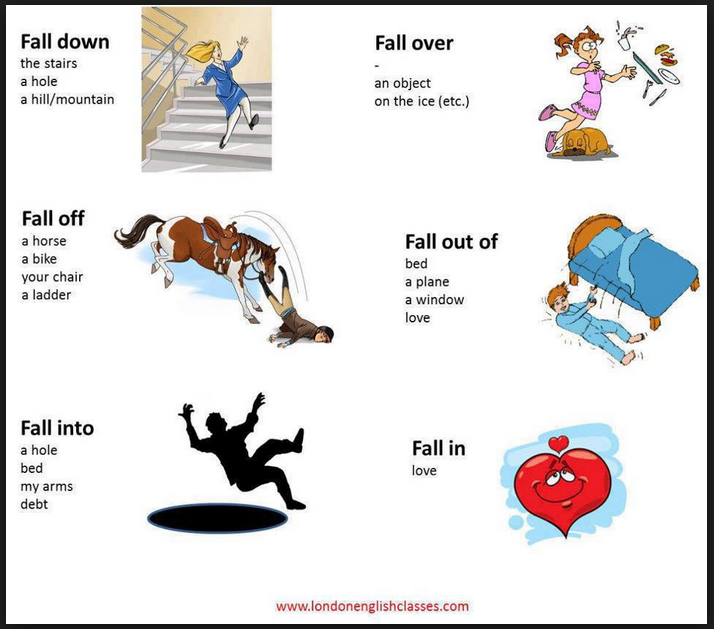
fall


take


Monday, August 11, 2014

difference between lately and recently

lately - (сүүлийн үед) 'Lately' generally refers to something that has (had) been going on for some time (e.g. the weather - 'very wet lately' etc), not to a specific incident. 
  • i think "lately" refers to a longer period than "recently"
recently - (саяхан)'Recently' can refer to a specific moment (an accident etc) or to something that had been going on for some time (but usually has now stopped)

What's the difference between "lately" and "recently"?
(I study English. I heard that I can say " she recently had an accident." but I cannot say" she lately had an accident." why cannot say lately in the sentence? What's the difference between lately and reently? 
Thank you!)

difference between aren't, ain't and amn't

aren't - () short form
1 are not
     ----- We aren't leaving tomorrow.
2 (in questions) am not
     ---- I'm invited, aren't I?
amn't - ()
 short form
(Scottish English, Irish English, non-standard)
 
am not
ain't - () short form
(non-standard orhumorous)
1 am not/is not/are not     ---- Things ain't what they used to be.2 has not/have not    ---- I ain't got no money.    ---- You ain't seen nothing yet!


Tag question - amn't I? - aren't I? - ain't I?


Countries and nationalities

Learn how to say the names of different countries and their associated nationalities in English.

Country is the name of the country as it is commonly used in English.

Adjective is the word used to describe something from the country, for example “French cheese”.

Nationality is the word used to describe a person from the country, for example “I am British”.

Inhabitant is the name of a person from the country, for example “A Kenyan won the London Marathon”.

Country and Nationality.docx


here is the original course for this post you can see it ------ http://www.speakenglish.co.uk/vocab/countries_and_nationalities

Countries & Nationalities

The word 'Nationality' is not often used in spoken English. It is a formal and official word and it appears more frequently in written English. You will find the word 'Nationality' is used a lot in the travel industry and for immigration.
We almost never say: What is your nationality?
We usually say: Where are you from? OR Where do you come from?
To tell someone your nationality you DON'T say: My nationality is Chilean.
You say: I'm Chilean

Remember
I am from Chile.
To Be + from + country

I am Chilean.
To Be + Nationality

SingularPlural
CountryCountries
NationalityNationalities

List of Countries, Nationalities and their Languages

Below is a list of countries with the appropriate nationality. The Language that appears is the main language that is spoken in the country. We have not included all the languages that they may speak in that country.

Countries & Nationality

This chart lists many of the countries or nations in the world, with the following information:
  • Name of country
  • Adjective used for that country (also describes nationality)
  • Noun used for a person from that country
Look at these example sentences:
She comes from France. She is French. Her nationality is French. She is a Frenchwoman. She drives a French car. She speaks French.
Country & Nationality.docx


here is original course for this post   ---- http://www.englishclub.com/vocabulary/world-countries-nationality.htm

Friday, August 8, 2014

4 ways how to focus


4 ways to focus.docx


here is original course for this document ---- http://www.wikihow.com/Focus

Wednesday, August 6, 2014

difference between annoy and aggravate


English Grammar - Inversion: "Had I known...", "Should you need..."


writing - Misplaced Modifiers


difference between as and like


difference between each other and one another


difference between rob, mug, and steal

rob - (тонох дээрэмдэх, тонох)to rob is to go into a store and steal something valuable
steal - (хулгйлах)This is used for THINGS and is done in secret. It happens when no one is looking. So you go out and you come back and something is gone~!
mug - (дээрэмдэх)This is used when someone forces you to give them your valuables on the street. Usually, with a gun or knife


difference between mug, rob, and steal

difference between a friend of mine and a friend of me

a friend of mine - () one of the friends. If I only have one friend and he is my only friend, we cannot then say "he is a friend of mine", because the "mine" doesn't mean a group of people. If I introduce my daughter I would never say
this is a daughter of mine
a friend of me - ()We (BE) don't say "a friend of me"

Why do you say “friend of mine” instead of “friend of me”?


  • In the construction
    friend of mine
    the "mine" means "my friends", so literally
     he is [one] friend of [all my friends]
    or more idiomatically,
    he is one of my friends
    If I only have one friend and he is my only friend, we cannot then say "he is a friend of mine", because the "mine" doesn't mean a group of people. If I introduce my daughter I would never say

difference between could/would/should/might/may/must have done

would have done - ()in the past you had some problems. so you couldn't do it in the past ( i would have done my graduation -- би сургуулиа дүүргэх байсан юм (хэрвээ тэгээгүй ингээгүй байсан бол))
could have done - ()you had possibility to do it in the past. but you made decision no to do it (i could have done my graduation --- би сургуулиа дүүргэж болох байсан юм)  
should have done - ()something was right or correct to do in the past but you did not do it (i should have done my graduation --- би сургуулиа дүүргэх хэрэгтэй байсан юм)

must have done - () you are sure that something happened in the past. but you don't know result. it means you are confident in yourself that happened exactly. but it can be not happened because you don't know. so you are surprised of it 

might have done - () you are not sure something happened in the past or not (there was party. but you don't know who did that party "i might have done this party = you cannot remember it whether you did or not(maybe you did it, maybe you did not it)")

may have done - ()you are not sure something happened in the past or not (there was party. but you don't know who did that party "i may have done this party = you cannot remember it whether you did or not(maybe you did it, maybe you did not it)")

needn't have done - () you did something but now you see that you did was not necessary (for example: George had to go out. He thought it was going to rain. So he decided to take the umbrella. "he needn't have taken the umbrella = he took the umbrella but this was not necessary. of course he did not know this when he went out" )


difference between should/could/would have done


Sunday, August 3, 2014

difference between look out the window, look through the window, and look out of the window

look out the window - ()walk out and walk out of case
look out and look out of are indeed veeeery similar in meaning. Look out the window requires that you be inside.If you're standing in a room with a large plate glass window and you want to call someone's attention to something outside, you'd probably say "look out the window" or just "look outside."

look out of the window - ()walk out and walk out of case
look out and look out of are indeed veeeery similar in meaning. Look out the window requires that you be inside
look through the window - ()If you're standing behind a doll's house and you want to call attention to a tiny painting in one of the rooms, you might point to one area of the doll's house and say "look through the window."
 Look through the window doesn't require that you be outside.


look through the window/look out the window

(Do they have the same meaning? Does "look out the window" implies opening the window?)

Saturday, August 2, 2014

difference between meet somebody, meet with somebody, and meet up with somebody

meet somebody - ()'Meet somebody' does not refer to a period of time, but rather to a point in time. To meet someone can be a chance encounter.
It can also be used for someone you have not seen before, or the first time you ever saw them1)  [intransitive, transitive, no passive] to come together socially after you have arranged it
      meet someone (for something)
             ------ We're meeting them outside the theater at 7.
2) to go to a place and wait there for a particular person to arrive
     meet someone
              ---- Will you meet me at the airport?
3) to see and know someone for the first time; to be introduced to someone
      meet (someone)
              ---- Pleased to meet you.
              ---- There's someone I want you to meet.
4) [intransitive, transitive, no passive] to be in the same place as someone by chance and talk to them
     meet someone
            ---- Maybe we'll meet again some time.
meet with somebody - ()'Meet with somebody' suggests more than just a moment. It suggests a period of time.  'meet with' suggests an extended, more formal discussion

meet with someone

 to meet someone, especially for discussions
       ----- The President met with senior White House aides.
meet up with somebody - ()'Meet up (with somebody)' does not refer to a period of time but sounds a little more informal than using 'meet somebody'. This is an informal get-together of a group of friends. Some may come to the meeting, some might not.

meet up (with someone)

to meet someone, especially by arrangement
       ------ They met up again later for a drink.

difference between no + singular and no + plural


grammar - No + singular/plural noun + singular/plural verb [closed]

(Which of the following phrases is grammatically correct?
  • no animal is
  • no animal are
  • no animals is
  • no animals are
  • )

    • The second and third are NEVER used. Whether you use 'no animal is', or 'no animals are' depends on whether you are talking in the singular or plural.

    no + plural/singular noun

    (I have a doubt. Would you use a singular or a plural noun after "no". Here is my context:

    - .... has no criteria
    - .... has no criterion)

    difference between any + singular and any + plural (any question or any questions)

    any + plural: (any stamps - ямар нэгэн маркнууд) to refer to an amount or a number of something - 
    used with uncountable or plural nouns in negative sentences and questions, after if or whether, and after some verbs such as prevent, ban, forbid, etc. to refer to an amount or a number of something, however large or small
           ----- Are there any stamps?
           ----- She asked if we had any questions.
           ----- You can't go out without any shoes.
    any + singular: (any bus - аль ч автобус байж болно) to refer to one of a number of things or people, when it does not matter which one
    used with singular countable nouns to refer to one of a number of things or people, when it does not matter which one
            ---- Take any book you like.
            ---- Any color will do.


    any questions or any question